
Primary and lower middle (ages 6–11)
At this stage the equipment supports observation and handling rather than measurement. Robustness matters more than accuracy; almost everything should survive being dropped.Observation — hand lenses, magnifying stands, simple stereo viewers, specimen pots
Measurement — beam balances, spring balances, metre rules, measuring jugs, sand timers
Physical science kits — magnet sets, simple circuit kits with buzzers and bulbs, ramps and trolleys, floating and sinking sets
Life science — plant growth trays, germination kits, simple body and plant models, life-cycle charts
Earth and weather — rain gauge, thermometer, wind vane, rock and mineral sets
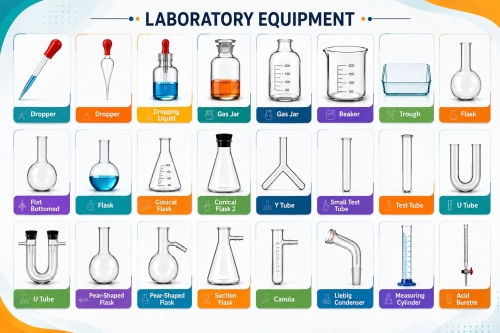
Plastic labware — beakers, funnels, droppers and trays in plastic rather than glass at this age
Middle school (ages 11–14)
The first real laboratory. Students begin measuring, recording and repeating, so accuracy starts to matter and glassware appears.Microscopes — elementary monocular models, plus stereo microscopes for whole specimens
Glassware — borosilicate beakers, conical flasks, test tubes, measuring cylinders, funnels
Heating — spirit lamps or Bunsen burners with tripods, gauzes and tongs
Physics — pulleys, inclined planes, calorimeters, ray boxes with lenses and mirrors, tuning forks
Electricity — cells, bulbs, switches, leads, ammeters and voltmeters at student grade
Biology — prepared slides, blank slides and cover slips, dissection alternatives, torso and organ models
Safety — goggles and aprons in class-set quantity from this stage onward
Secondary (ages 14–16)
Board practicals begin, and the equipment list starts being dictated by a prescribed syllabus rather than by choice. Quantities matter as much as specification here, because every student must perform every listed practical.Physics — vernier callipers, micrometer screw gauges, optical bench, resistance boxes, meter bridge, potentiometer, sonometer
Chemistry — burettes, pipettes, volumetric flasks, desiccators, gas preparation sets, salt analysis reagent racks
Biology — laboratory monocular microscopes, microtome and staining sets, dissection instruments, environmental test kits
Shared — electronic balances, hot plates, water baths, distilled water supply
Turning point: this is the grade band where demonstration quantities stop being acceptable. Below it, a shared set can work; here, every group needs its own.
Senior secondary and pre-university (ages 16–18)
Instrument grade steps up again, and specialised apparatus appears for the first time. Numbers can fall — streams are smaller — but per-unit specification rises.Physics — spectrometers, photoelectric effect apparatus, semiconductor and transistor characteristic kits, e/m apparatus, Geiger counters, travelling microscopes
Chemistry — precision balances, distillation and fractionation sets, conductivity and pH meters, thermostatic baths
Biology — binocular and research microscopes, centrifuges, incubators, chromatography and electrophoresis sets
Mathematics — conic-section models, solid geometry sets, statistics and probability kits
What each grade band needs, at a glance - Primary Middle Secondary Senior
Microscope Hand lens, stereo viewer Elementary and laboratory monocular Binocular, research, phase contrastBalance Beam and spring balance Electronic, 0.01 g class Precision and analytical
Labware Plastic Borosilicate Borosilicate, volumetric grade
Electricity Bulb-and-cell circuit kits Meters, resistance boxes, meter bridge Semiconductor and CRO work
Biology Models and charts Slides, dissection sets, microtomes Centrifuge, incubator, chromatography
Items worth buying once, for every grade
Storage — labelled trays and cupboards outlive every instrument in the roomSafety kit — goggles, aprons, eyewash, fire blanket, first aid
Charts and models — used from middle school to senior year with no change
Trolleys — class sets are moved between rooms far more than schools plan for
Spares — bulbs, leads, fuses, cover slips; small money, large downtime avoided
FAQ - School Science Lab Supplies The Complete List
Can junior classes use the senior laboratory?They can share a room, but not a stock cupboard. Junior sets should be stored and issued separately, or senior apparatus is worn out by students who do not yet need it.
Which purchase is most often made too early?
High-magnification microscopes and precision balances. Both are bought at senior grade for middle-school rooms and spend years underused.
Which is most often made too late?
Class-set quantities. Schools buy the right item and too few of it, then discover at board practical time that the class cannot be examined in one session.
Get this priced for your lab
Send the practical list, the room plan or the tender document and get an itemised quotation with quantities, packing, freight and installation priced separately.
