
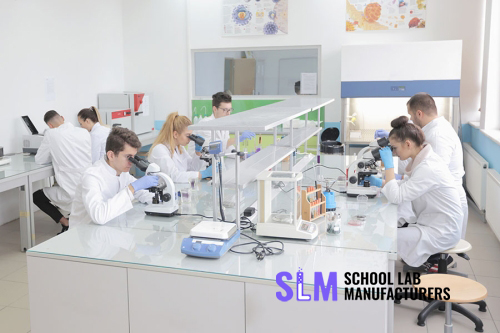
Kenya Certificate of Secondary Education (KCSE) Biology Paper 3 is the practical examination — it tests students on their ability to perform biological investigations, identify specimens, make accurate observations and measurements, and draw valid conclusions. Every school preparing students for KCSE biology needs to have the specific apparatus on the KNEC biology practical requirements list. This guide covers everything you need to know about KNEC biology practical requirements and which apparatus your school must have.
What is KNEC Biology Paper 3?
KNEC Biology Paper 3 is the hands-on part of KCSE Biology — a 2-hour 45-minute exam held at the school with KNEC supervisors present. Students are tested on three types of practical work: dissection and specimen observation, microscopy (using a compound microscope to look at prepared slides or fresh specimens), and ecology/environmental studies (using field equipment and data analysis). Paper 3 makes up 25% of the total KCSE Biology grade.
KNEC Biology Practical Apparatus List — What Every School Needs
Here's what every school must have available and in good working condition before KNEC examinations:
Compound binocular microscope (minimum 40x, 100x, 400x magnification) — one per group of 6 students. Our SLM-MSB-100 binocular microscope meets all KNEC requirements.
Prepared microscope slides — blood smear, onion epidermis, cheek epithelium, leaf cross-section, root tip (mitosis). Available in our 50-slide comprehensive set.
Dissection kit — scalpel, scissors, forceps, mounted needle (minimum 6-piece per student). Our SLM-DK-12 12-piece dissection kit exceeds the KNEC minimum.
Dissection tray — white wax base, 35cm × 25cm, with pins.
Human skeleton model — 170cm life-size, fully articulated with numbered bones. SLM-HSM-170.
Human anatomy torso model — showing major organs, removable. SLM-HAT-24 (24-part).
Human heart model — dissectible, showing internal chambers. SLM-HHM-5 (5-part).
Human eye model — dissectible, showing internal structures. SLM-HEM-6 (6-part).
Hand lens 10x — for external specimen observation.
Measuring cylinder 100ml and 250ml — borosilicate glass.
Thermometer 0-100°C — mercury-free recommended.
Spring balance set (1N, 5N, 10N) — for mass measurement.
Metre rule — for length measurement.
Specimen jars with lids — 250ml and 500ml for preserving organisms.
Hand gloves and safety goggles — for student safety during dissection and chemical handling.
What Happens if a School Does Not Have the Required KNEC Apparatus?
If a school doesn't have the required KNEC biology practical apparatus, KNEC can bar that school from hosting the practical examination, meaning students have to travel to another school — which is a major hassle. On top of that, students who can't access the required apparatus during practical preparation (throughout Form 1-4) are at a serious disadvantage in KCSE Paper 3. Schools that have all the required apparatus consistently produce higher KCSE biology Paper 3 grades.
How to Order KNEC-Compliant Biology Lab Equipment from schoollabmanufacturers.com
schoollabmanufacturers.com supplies KNEC-compliant biology lab kits from Ambala Cantt, India. Every KNEC biology kit includes all items on the KNEC apparatus list plus a KNEC compliance letter confirming alignment to the current KCSE biology apparatus list. Delivery to Mombasa port: 22-28 days. Air freight to JKIA Nairobi: 5-7 days.
Contact: sales@schoollabmanufacturers.com | WhatsApp: +91-9896600003 | ISO 9001:2015 Certified | Manufacturing since 1996 | Ambala Cantt, Haryana, India
