
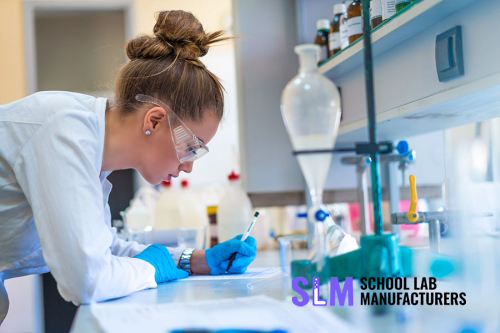
School chemistry labs use a lot of different glassware — and grabbing the wrong piece for an experiment will throw off your results or create a safety issue. Here's what each major type is actually for, when to use it, and what you can sub in if the right one isn't around.
Beaker — General Purpose Container
A beaker is a wide cylindrical glass container with a small lip for pouring. You'll use it for heating liquids, dissolving solids, mixing solutions, and holding liquids during experiments. Beakers are graduated but their accuracy is low — don't use one for precise volume measurement. Available in 50ml, 100ml, 250ml, 500ml, and 1000ml. Used in every WAEC and KNEC chemistry practical.
Conical Flask (Erlenmeyer Flask) — Titration and Mixing
A conical flask has a narrow neck and wide conical body — the shape lets you swirl without spilling. Main use: receiving flask in titrations (the solution being titrated goes in here). Also handy for heating liquids, preparing solutions, and culture work in biology. The 250ml conical flask is the standard titration flask for WAEC and KNEC chemistry.
Burette — Accurate Volume Delivery
A burette is a long calibrated tube with a stopcock at the bottom. It measures the exact volume of solution delivered during a titration — accurate to 0.05ml (Class A). Fill it with the titrant (usually the acid or base being added) and read the volume before and after. A 50ml Class A burette is on every WAEC and KNEC chemistry apparatus list.
Pipette — Accurate Volume Transfer
A pipette transfers an exact volume of liquid — accurate to 0.02–0.05ml (Class A). Two types: volumetric pipette (transfers one fixed volume, e.g., exactly 25.00ml) and graduated pipette (can transfer any volume up to its maximum). Volumetric pipettes are used in titrations to measure the standard solution going into the conical flask. Graduated pipettes are used for making solutions. 25ml and 20ml volumetric pipettes are on the WAEC chemistry apparatus list.
Measuring Cylinder — Approximate Volume Measurement
Use a measuring cylinder when you only need an approximate volume — accurate to ±1–2ml. Good for preparing rough solutions, measuring liquids for heating, or anytime burette or pipette accuracy isn't necessary. Available in 10ml, 25ml, 50ml, 100ml, 250ml, 500ml, and 1000ml. Never use one where a burette or volumetric pipette should go — the accuracy just isn't there.
Test Tube — Small-Scale Reactions
Test tubes are small cylindrical glass tubes used for small-scale chemical reactions, heating small quantities, temporary reagent storage, and microbiology cultures. Boiling tubes are wider versions for more vigorous reactions or larger volumes. Test tubes are the most commonly used piece of glassware in school chemistry and biology labs.
All glassware from schoollabmanufacturers.com is borosilicate — resistant to thermal shock and chemical attack, suitable for all standard school chemistry and biology experiments.
Contact: sales@schoollabmanufacturers.com
